Physical Address
304 North Cardinal St.
Dorchester Center, MA 02124
Physical Address
304 North Cardinal St.
Dorchester Center, MA 02124

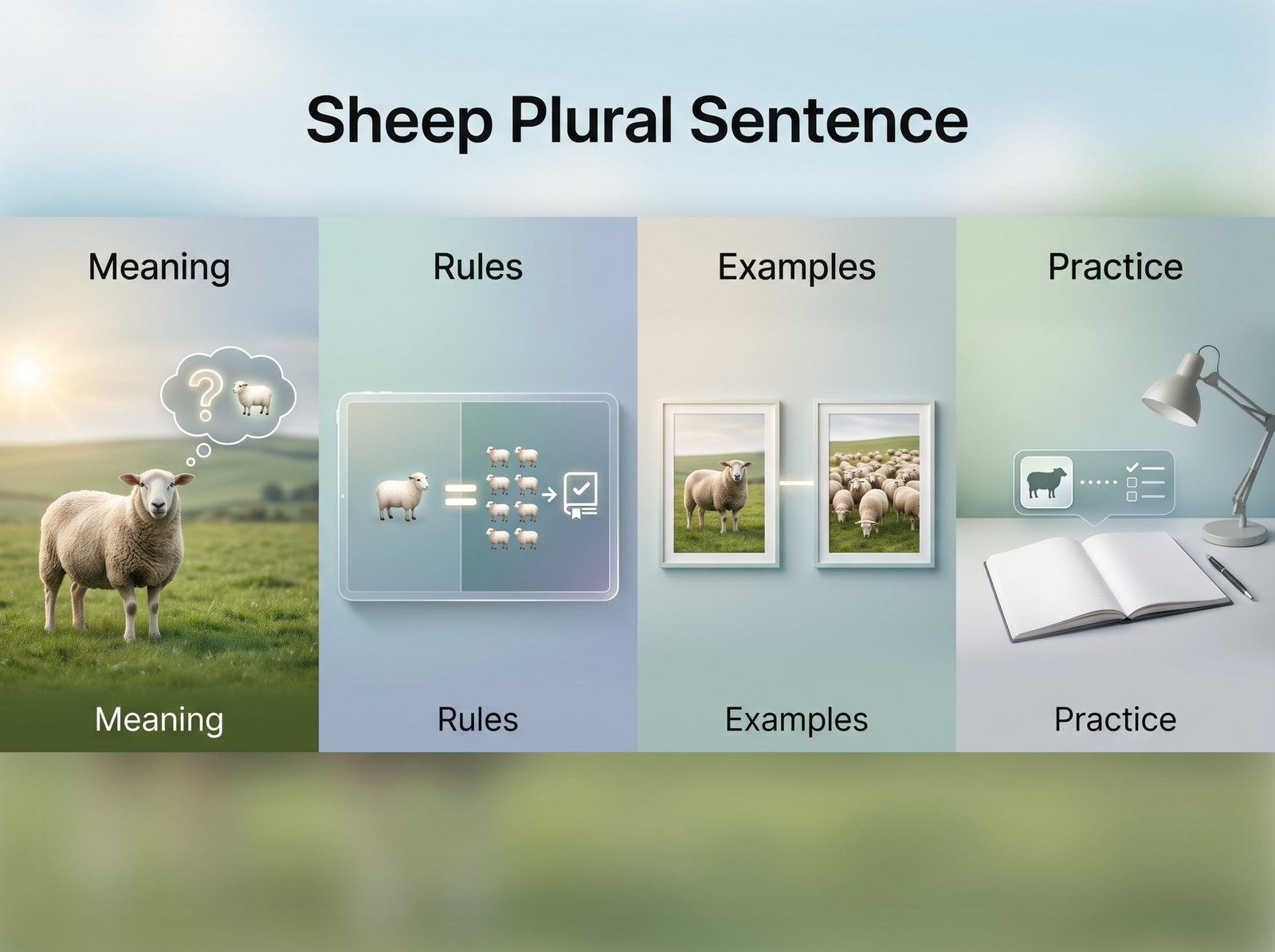
Have you ever written sheeps and wondered if it sounds right? You’re not alone. A Sheep Plural Sentence can feel confusing because the noun stays unchanged. The plural of sheep is simply sheep, whether you mean one animal or several. Once you learn the pattern, the rule becomes easy to remember and use.
This guide explains the sheep plural word in clear, everyday language. You’ll see how the plural form of sheep works in sentences, how verbs change, and why nearby words matter. For example, “One sheep is resting” sounds different from “Five sheep are grazing,” even though the noun looks identical.
You’ll also practice the plural form sheep pattern with helpful examples and quick tips. By the end, you’ll know when to use is or are, avoid the common mistake sheeps, and write naturally with confidence.
Many English learners wonder whether the plural of sheep is sheeps. The answer is simple: sheep works for both one animal and more than one.
You can write:
The word stays the same, but the rest of the sentence shows whether it refers to a singular noun or a plural noun.
The plural of sheep is sheep, not sheeps. This noun doesn’t take an extra -s when you’re talking about several animals.
For example:
The article, number word, and verb provide important clues. A sheep means one animal, while many sheep means more than one.
Most regular nouns form plurals by adding -s or -es. For example, horse becomes horses, and box becomes boxes. However, sheep belongs to a group of irregular nouns that don’t change between singular and plural forms.
English has several nouns with this pattern:
You’ll need to use context rather than spelling alone to identify the grammatical number.
The following examples show how sheep works as both a singular and plural noun.
Use a singular verb when sheep refers to one animal.
Words such as a, one, this, and that usually signal that the noun is singular.
Use a plural verb when sheep refers to two or more animals.
Here, words like many, several, those, and two make the plural meaning clear.
Since the spelling stays unchanged, check the words around sheep. This is especially important when choosing the correct verb.
| Clue | Singular example | Plural example |
| Article or quantity | A sheep is nearby. | Five sheep are nearby. |
| Demonstrative | This sheep looks tired. | These sheep look tired. |
| Verb | The sheep was quiet. | The sheep were quiet. |
| Quantifier | One sheep escaped. | Several sheep escaped. |
The sentence’s determiner and verb often reveal the intended meaning. For example, the sheep is describes one animal, while the sheep are describes multiple animals.
In standard English, sheeps isn’t the plural form of the animal. Use sheep instead.
Incorrect:
Correct:
You may occasionally see sheeps in a specialized context, such as a technical discussion about different types or varieties of sheep. However, ordinary writing and conversation require sheep.
The word sheep appears in several familiar expressions. These phrases often describe behavior, trust, or someone who doesn’t fit in.
For example, you might say, “He’s considered the black sheep of his family because he chose a completely different career.”
Specific terms describe sheep at different stages of life or based on sex.
For example, “The ewe stayed close to her lamb,” while “The ram stood at the front of the flock.” These words add precision when general references to sheep aren’t specific enough.
A group of sheep is most commonly called a flock. You can also hear herd of sheep, but flock is the more natural everyday expression.
Examples include:
The word flock is a collective noun. Depending on the variety of English and the writer’s meaning, it may take a singular or plural verb. In American English, writers often use a singular verb when treating the group as one unit: The flock is moving downhill.
Sheep is usually a countable noun when you’re counting individual animals. You can say:
Although the form doesn’t change, the noun still has a singular and plural meaning. The number comes from surrounding words rather than an ending.
For example, two sheep clearly identifies two animals, while some sheep indicates an unspecified number.
These three forms can look confusing, but they serve different purposes.
Examples:
For plural possession, write sheep’s in many general contexts when the noun remains unchanged, or use a clearer phrase such as the wool of the sheep. In formal writing, context can help avoid ambiguity.
Sheep isn’t the only English noun that keeps one form for singular and plural. These words follow a similar pattern:
Examples:
Some nouns have special variations depending on meaning or dialect. Fish, for instance, commonly serves as both singular and plural, while fishes can refer to different species in scientific or specialized writing.
Complete each sentence with sheep.
The noun remains unchanged each time. To identify singular or plural meaning, look at words such as one, a, those, and several.
Use sheep whenever you refer to one or more animals. Don’t add -s simply because the sentence describes several.
A quick check can help:
For example:
The noun stays unchanged, but the verb changes to match the subject.
Remember these key points:
The plural of sheep is sheep. The spelling stays unchanged when referring to multiple animals.
No. Sheeps isn’t the standard plural form. Write sheep for both one animal and several animals.
Use sheep with singular or plural context: “One sheep is here” or “Many sheep are grazing.”
Check nearby words and the verb. “A sheep is” is singular, while “several sheep are” is plural.
Sheep is irregular because its singular and plural forms are identical instead of adding -s or -es.
Yes. Both phrases are correct: one sheep means one animal, and two sheep means two animals.
A group of sheep is usually called a flock. The phrase herd of sheep is also understandable.
Understanding a Sheep Plural Sentence is easier once you remember one simple rule: the word sheep stays the same for one animal or several. The plural of sheep is still sheep, not sheeps. For example, you can write, “One sheep is near the gate” or “Several sheep are grazing nearby.” The surrounding words and verbs show whether the noun is singular or plural.
Remember that sheep plural word usage depends on context. The plural form of sheep doesn’t change its spelling, but the sentence may change around it. Use is with one sheep and are with multiple sheep. This small detail helps you create clear, accurate sentences in schoolwork, everyday writing, and formal communication.
Now you know the correct plural form sheep pattern and can use it confidently. When in doubt, look for words such as one, a, many, or several. They reveal the intended meaning. With a little practice, sheep grammar becomes straightforward, natural, and easy to remember.


